Introduction: A New Era for C# Performance
Honestly, C# has had an incredible run over the last twenty years. It’s easily one of the most balanced languages out there, but I think people often forget how much of that heavy lifting is actually done by the JIT compiler. The way it optimizes everything on the fly at runtime is really what gives it that performance edge.
But in 2026, Microsoft introduced Native AOT in .NET 10. The performance floor has shifted. Now that .NET 10 has fully leaned into Native AOT, the trade-offs have changed. In a world of real-time AI and massive container clusters, ‘fast enough’ doesn’t cut it. We need that immediate execution and smaller footprint to stay competitive, especially when you’re scaling a thousand instances where every megabyte of overhead adds up.
This is where Native AOT (Ahead-of-Time compilation) in .NET 10 becomes a game changer.

What is Native AOT?
Native AOT (Ahead-of-Time compilation) is a compilation model where your C# application is compiled directly into native machine code before execution, rather than at runtime.
Traditional Model (JIT)
- Code compiled to Intermediate Language (IL)
- JIT compiles IL → machine code at runtime
- Pros: Flexibility, dynamic optimizations
- Cons: Startup delay, higher memory usage
Native AOT Model
- Code compiled directly into machine code during publish
- No JIT compilation required at runtime
- Pros: Instant startup, smaller footprint, improved security
Native AOT vs JIT – Advantages & Disadvantages
| Category | Native AOT (.NET 10) | JIT Compilation (Traditional .NET) |
|---|---|---|
| 🚀 Startup Time | Very fast (<20ms) | Slow (100–300ms due to JIT warm-up) |
| 📦 Memory Usage | Low (no JIT overhead) | Higher memory usage |
| 📁 Binary Size | Smaller runtime dependency, but can produce larger standalone binaries | Smaller app binaries but requires full runtime |
| ⚡ Execution Speed | Similar or slightly faster in some cases | Optimized at runtime, can be very efficient |
| 🔒 Security | More secure (no runtime code generation) | Vulnerable to some runtime injection techniques |
| ☁️ Cloud Cost | Lower (less RAM + faster scaling) | Higher due to resource usage |
| 🔄 Reflection Support | Limited / requires configuration | Full support |
| 🧩 Library Compatibility | Not all libraries supported | Full ecosystem compatibility |
| 🛠 Build Time | Longer (ahead-of-time compilation) | Faster builds |
| 🐞 Debugging | More complex | Easier debugging experience |
| 🔧 Deployment | No runtime required (self-contained) | Requires .NET runtime installed |
| 📈 Scalability | Excellent for microservices & serverless | Good, but slower cold starts |
| 🧠 Flexibility | Less dynamic | Highly flexible (runtime optimizations) |
✅ Choose Native AOT when you need speed, low memory, and cloud efficiency. ✅ Choose JIT when you need flexibility, reflection, and full library support
🚀 Project: Native AOT vs JIT Performance Benchmark
🧱 Solution Structure
AOTPerformanceDemo/
 ├── JitApp/          (Standard .NET Console App)
 ├── AotApp/          (Native AOT Console App)
 └── BenchmarkRunner/ (Measures performance)
Create the Solution
dotnet new sln -n AOTPerformanceDemo
dotnet new console -n JitApp
dotnet new console -n AotApp
dotnet new console -n BenchmarkRunner
dotnet sln add JitApp
dotnet sln add AotApp
dotnet sln add BenchmarkRunner
Add Sample Workload (Same Code in Both Apps)
Replace Program.cs in JitApp and AotApp:
using System.Diagnostics;

Console.WriteLine("App starting...");
var sw = Stopwatch.StartNew();
var result = HeavyComputation();

sw.Stop();
Console.WriteLine($"Result: {result}");
Console.WriteLine($"Execution Time: {sw.ElapsedMilliseconds} ms");

static long HeavyComputation()
{
    long sum = 0;    for (int i = 0; i < 10_000_000; i++)
    {
        sum += i;
    }    return sum;
}
Enable Native AOT (Only for AotApp)
Edit AotApp.csproj:
<Project Sdk="Microsoft.NET.Sdk">
<PropertyGroup>
    <OutputType>Exe</OutputType>
    <TargetFramework>net10.0</TargetFramework>

    <!-- Enable Native AOT -->
    <PublishAot>true</PublishAot>
    <!-- Reduce size -->
    <PublishTrimmed>true</PublishTrimmed>
    <InvariantGlobalization>true</InvariantGlobalization>
  </PropertyGroup>
</Project>
Build Both Versions
🔹 Build JIT App
dotnet build JitApp -c Release🔹 Publish Native AOT App
dotnet publish AotApp -c Release -r win-x64👉 Output:
AotApp/bin/Release/net10.0/win-x64/publish/AotApp.exeBenchmark Runner
Replace BenchmarkRunner/Program.cs:using System.Diagnostics;
RunTest("JIT App", @"..\JitApp\bin\Release\net10.0\JitApp.exe");
RunTest("Native AOT App", @"..\AotApp\bin\Release\net10.0\win-x64\publish\AotApp.exe");
static void RunTest(string name, string path)
{
Console.WriteLine($"\nRunning {name}...");
var sw = Stopwatch.StartNew();
var process = new Process
{
StartInfo = new ProcessStartInfo
{
FileName = path,
RedirectStandardOutput = true,
UseShellExecute = false
}
};
process.Start();
process.WaitForExit();
sw.Stop();
Console.WriteLine($"{name} Total Time (including startup): {sw.ElapsedMilliseconds} ms");
}Run Benchmark
dotnet run --project BenchmarkRunner -c ReleaseFind the complete implementation and benchmarking project on GitHub
Result
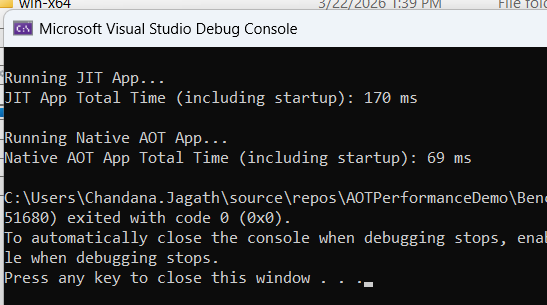
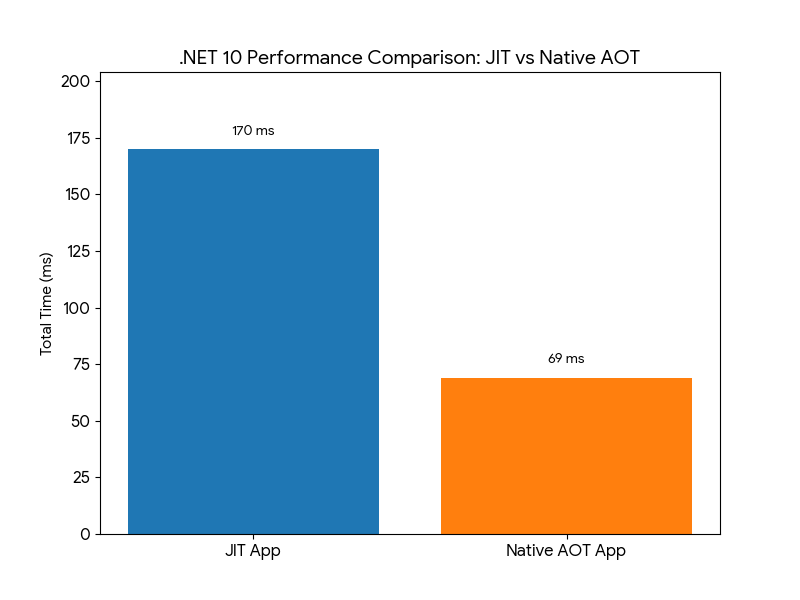
Based on the results shown in my terminal, here is a visual comparison of the performance gap between the standard JIT approach and the new Native AOT in .NET 10.
.NET 10 Performance: JIT vs Native AOT
The data reflects the following metrics from my run:
- JIT App (Standard): 170 ms total execution time.
- Native AOT App: 69 ms total execution time.
This represents a ~60% reduction in startup and execution time for the Native AOT version.
Analysis of the Graph
- The “Cold Start” Gap: The 101ms difference you see is the time the JIT version spent loading the runtime and compiling Intermediate Language (IL) into machine code. The Native AOT version effectively “skipped” this phase because it was already pre-compiled.
- Operational Impact: In a local environment, 170ms feels fast, but in a production environment where you might be scaling hundreds of micro-containers, this difference determines how quickly your system can react to a sudden spike in traffic.
- Consistency: Native AOT provides a much more predictable “p99” startup time. While JIT performance can vary slightly depending on the CPU load during the compilation phase, AOT is nearly constant because the heavy lifting was done at build time.
2 thoughts on “Native AOT in .NET 10: Everything for C# Developers”
I like how detailed this is.
Thank you
Comments are closed.